
Gun Violence is a
Public Health Crisis

Preventing gun violence requires collaboration across disciplines. The resources below provide tools for research, data collection, learning, prevention, and advocacy.

Data Repositories

Reach out to the help desk if you intend on exporting data from the Atlas of American Gun Violence. They will make the process frictionless.

The Trace is doing phenomenal work streamlining gun violence research. Access their hub for loads of datasets! 

The CDC Wide-ranging ONline Data for Epidemiologic Research (WONDER) is a reference point for all of the amazing datasets the CDC has collected/compiled. 

Other CDC Resources

NVS: While not gun specific, deaths from all causes from every county in the United States is published by the CDC National Vital Statistics System.

WISQARS: CDC Web-based Injury Statistics Query and Reporting System allows you to see fatal, nonfatal, and cost of injury data.

NVDRS: The CDC National Violent Death Reporting System publishes data on violent deaths including homicides, suicides, and deaths caused by law enforcement acting in the line of duty.

There are multiple datasets, ongoing and historical, focusing on gun violence. 

The Youth Risk Behavior Surveillance System (YRBSS) inquires about gun carrying and violent behavior in a nationally representative sample. You can conduct individual level analyses using other survey questions.

Additional Resources to Get Started

1

The Trace published a helpful guide to using the CDC WONDER system. You can access it here

2

This innovative program based in a University focuses on developing and assessing gun violence interventions in the local area. Interesting information for innovative programming.

3

This website allows you to see quick visualizations and fast facts (with citations!)

Thoughtful Incorporation of Place-Based Indicators

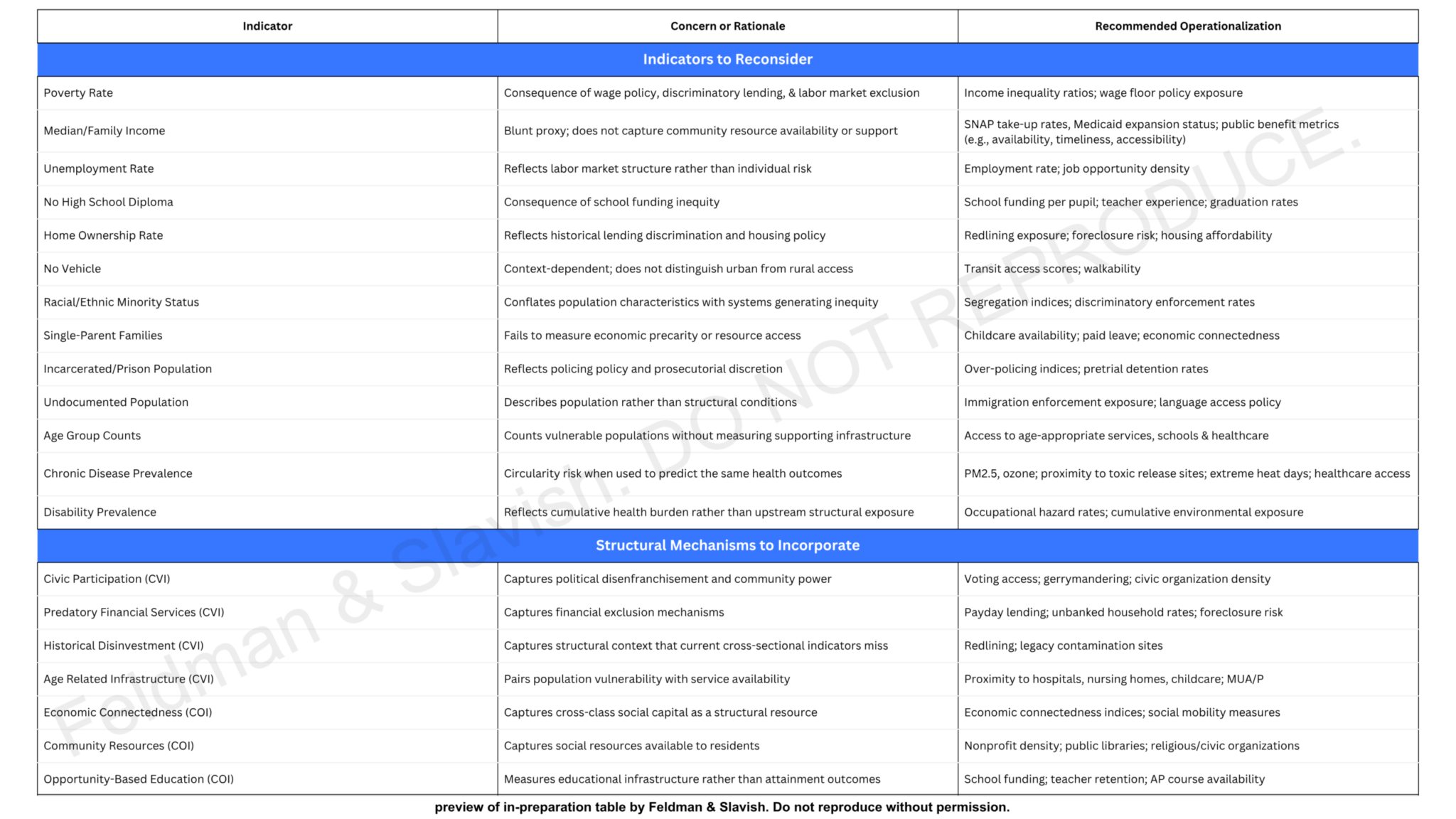
Many gun violence and public health studies use place-based indices to capture neighborhood context. This table, from an upcoming paper (Feldman & Slavish, in preparation), highlights common problems with indicators frequently included in these indices. Being thoughtful about what we measure and why is especially important when the outcomes we study (e.g., gun violence) reflect the downstream effects of structural inequities that disproportionately affect communities of color.
Keep It Political!

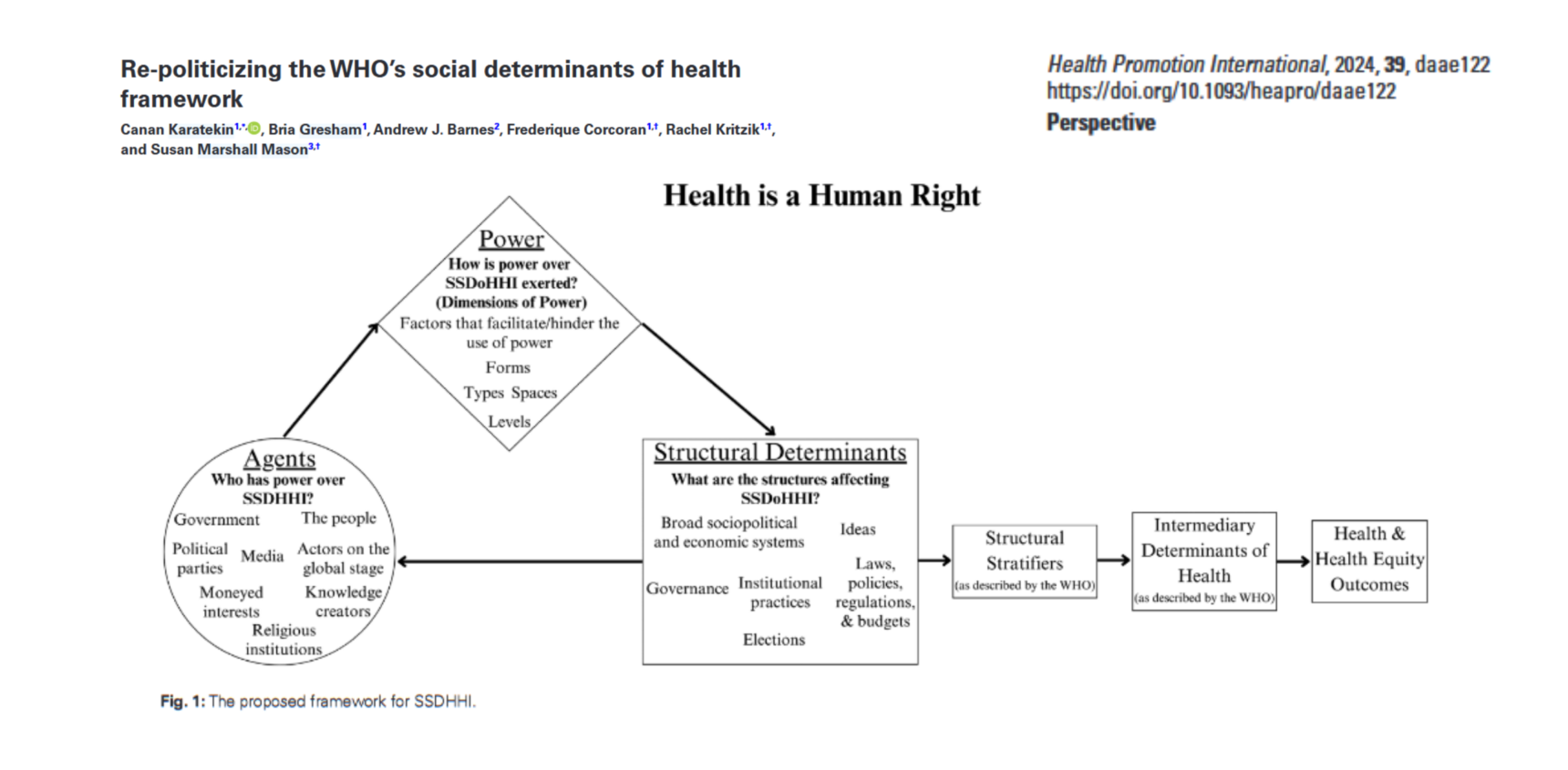
Much of social determinants of health research has become de-politicized, with work increasingly focused on downstream, individual-level conditions rather than the upstream agents and power dynamics that produce them in the first place. Applied to gun violence research, this critique is especially salient. As the authors note, housing discrimination through redlining dating back to the early 1900s in the USA still contributes to disparities in the geography of gun violence, with these consequences predominantly faced by Black communities.

Keeping this political takes many forms, but at its root it means identifying the agents and power dynamics that shape structural determinants (see Figure below; detailed in manuscript). That looks like naming specific agents and decisions (e.g., a particular piece of legislation, a court ruling, a funding restriction) rather than gesturing vaguely at “policy.” The authors also encourage an expansion of who counts as affected. For example, a study of the 2002 Beltway sniper attacks found that in-utero exposure to the three-week shooting spree increased low birth weight and premature births in affected areas by 25%, nudging us to remember that the costs of gun violence extend far beyond its immediate victims. As mentioned above, this includes thoughtfully operationalizing structural exposures.
Learn More

This is a list of resources that I have found personally meaningful in my journey to be a better researcher and advocate in the prevention of gun violence and health equity.

  • Esposti, M. D., Gravel, J., Kaufman, E. J., Delgado, M. K., Richmond, T. S., & Wiebe, D. J. (2022). County-Level Variation in Changes in Firearm Mortality Rates Across the US, 1989 to 1993 vs 2015 to 2019. JAMA Network OPEN. https://doi.org/10.21428/cb6ab371.60edae0a
  • Goldstick, J. E., Carter, P. M., & Cunningham, R. M. (2021). Current Epidemiological Trends in Firearm Mortality in the United States. JAMA Psychiatry, 78(3), 241. https://doi.org/10.1001/jamapsychiatry.2020.2986
  • Hildenbrand, A. K., Daly, B. P., Nicholls, E., Brooks-Holliday, S., & Kloss, J. D. (2013). Increased Risk for School Violence-Related Behaviors Among Adolescents With Insufficient Sleep. Journal of School Health, 83(6), 408–414. https://doi.org/10.1111/josh.12044
  • Kalesan, B., Mobily, M. E., Keiser, O., Fagan, J. A., & Galea, S. (2016). Firearm legislation and firearm mortality in the USA: A cross-sectional, state-level study. The Lancet, 387(10030), 1847–1855. https://doi.org/10.1016/S0140-6736(15)01026-0
  • Kim, D. (2019). Social determinants of health in relation to firearm-related homicides in the United States: A nationwide multilevel cross-sectional study. PLOS Medicine, 16(12), e1002978. https://doi.org/10.1371/journal.pmed.1002978
  • Liu, Y., Siegel, M., & Sen, B. (2022). Association of State-Level Firearm-Related Deaths With Firearm Laws in Neighboring States. JAMA Network Open, 5(11), e2240750. https://doi.org/10.1001/jamanetworkopen.2022.40750
  • Morris, M. C., Vearrier, L., Kutcher, M. E., Karimi, M., Faruque, F., Severance, A., Brassfield, M., & Zhang, L. (2025). Understanding disparities in firearm mortality: The role of person- and place-based factors. Injury, 56(5), 112275. https://doi.org/10.1016/j.injury.2025.112275
  • Pear, V. A., Castillo-Carniglia, A., Kagawa, R. M. C., Cerdá, M., & Wintemute, G. J. (2018). Firearm mortality in California, 2000–2015: The epidemiologic importance of within-state variation. Annals of Epidemiology, Special Issue on Pandemic Influenza, 28(5), 309-315.e2. https://doi.org/10.1016/j.annepidem.2018.03.003
  • Roberts, B. K., Nofi, C. P., Cornell, E., Kapoor, S., Harrison, L., & Sathya, C. (2023). Trends and Disparities in Firearm Deaths Among Children. Pediatrics, 152(3), e2023061296. https://doi.org/10.1542/peds.2023-061296
  • Royle, M. L., Connolly, E. J., Nowakowski, S., & Temple, J. R. (2023). Sleep duration, sleep quality, and weapon carrying in a sample of adolescents from Texas. Preventive Medicine Reports, 35, 102385. https://doi.org/10.1016/j.pmedr.2023.102385
  • Semenza, D. C., Silver, I. A., Stansfield, R., & Bamwine, P. (2024). Local gun violence, mental health, and sleep: A neighborhood analysis in one hundred US Cities. Social Science & Medicine, 351, 116929. https://doi.org/10.1016/j.socscimed.2024.116929
  • Cowan, K., Haight, S., Edwards, J., Luben, T., & Martin, C. (2025). Does choice of neighborhood disadvantage index matter? An application with preterm birth disparities in North Carolina. Annals of Epidemiology, 107, 54–60. https://doi.org/10.1016/j.annepidem.2025.05.014
  • Dow, D. (2024). Mapping Health Disparities: Delaware Journal of Public Health, 10(1), 106–110. https://doi.org/10.32481/djph.2024.03.14
  • Getis, A. (2010). Spatial Autocorrelation. In M. M. Fischer & A. Getis (Eds.), Handbook of Applied Spatial Analysis (pp. 255–278). Springer Berlin Heidelberg. https://doi.org/10.1007/978-3-642-03647-7_14
  • Jerrett, M., Gale, S., & Kontgis, C. (2010). Spatial Modeling in Environmental and Public Health Research. International Journal of Environmental Research and Public Health, 7(4), 1302–1329. https://doi.org/10.3390/ijerph7041302
  • Jia, P., Yu, C., Remais, J. V., Stein, A., Liu, Y., Brownson, R. C., Lakerveld, J., Wu, T., Yang, L., Smith, M., Amer, S., Pearce, J., Kestens, Y., Kwan, M.-P., Lai, S., Xu, F., Chen, X., Rundle, A., Xiao, Q., … James, P. (2020). Spatial Lifecourse Epidemiology Reporting Standards (ISLE-ReSt) statement. Health & Place, 61, 102243. https://doi.org/10.1016/j.healthplace.2019.102243
  • Jones-Webb, R., & Wall, M. (2008). Neighborhood Racial/Ethnic Concentration, Social Disadvantage, and Homicide Risk: An Ecological Analysis of 10 U.S. Cities. Journal of Urban Health, 85(5), 662–676. https://doi.org/10.1007/s11524-008-9302-y
  • Mohebbi, M., Wolfe, R., & Forbes, A. (2014a). Disease Mapping and Regression with Count Data in the Presence of Overdispersion and Spatial Autocorrelation: A Bayesian Model Averaging Approach. International Journal of Environmental Research and Public Health, 11(1), 883–902. https://doi.org/10.3390/ijerph110100883
  • Mohebbi, M., Wolfe, R., & Forbes, A. (2014b). Disease Mapping and Regression with Count Data in the Presence of Overdispersion and Spatial Autocorrelation: A Bayesian Model Averaging Approach. International Journal of Environmental Research and Public Health, 11(1), 883–902. https://doi.org/10.3390/ijerph110100883
  • Werner, A. K., & Strosnider, H. M. (2020). Developing a surveillance system of sub-county data: Finding suitable population thresholds for geographic aggregations. Spatial and Spatio-Temporal Epidemiology, 33, 100339. https://doi.org/10.1016/j.sste.2020.100339
  • Zolotor, A., Huang, R. W., Bhavsar, N. A., & Cholera, R. (2023). Quantifying Associations Between Child Health and Neighborhood Social Vulnerability: Does the Choice of Index Matter? Pediatrics. https://doi.org/10.1101/2023.06.20.23291679

Come Back Soon!

As I find more resources, I will update this page! In the meantime, I would love to hear from you! What gun violence research are you currently working on?